

For a while I’ve wanted an AI that sits above my work instead of inside it. Not another chatbot I open and prompt, but something I can hand a messy, half-formed instruction to and trust to figure out who or what should actually handle it.
So I built one. I’m calling him Chief, because that’s the job: chief of staff. I like the name, and it stuck immediately.
Here’s how Chief came together, and where I’m taking him next.
The harness underneath: Hermes
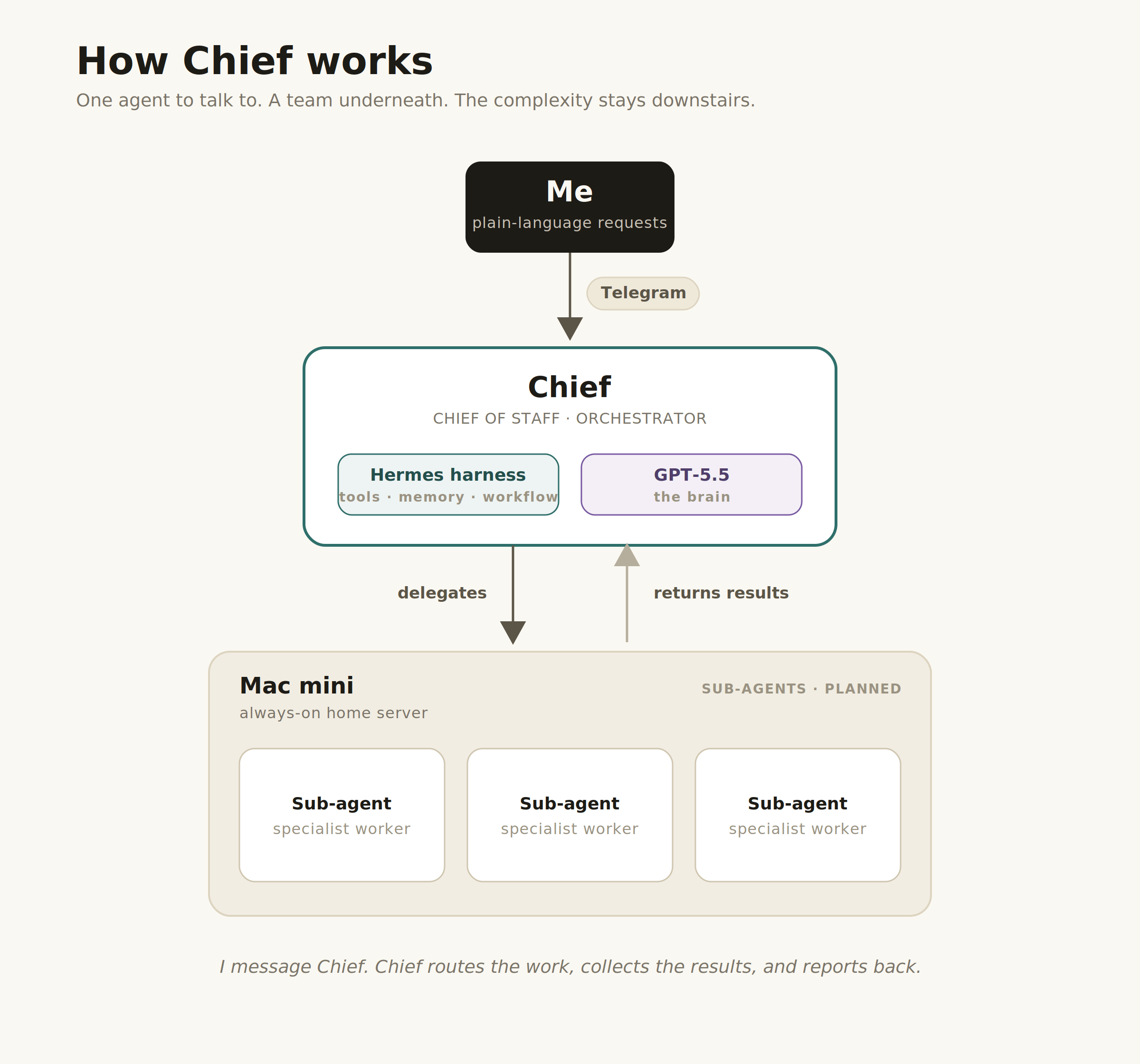
Chief runs on Hermes, an open-source agent harness from Nous Research. If you haven’t run into the term, a harness is the layer that wraps around an AI model and gives it the things a raw model lacks: tools, memory, and a workflow structure for getting real work done over time. The model is the engine. The harness is the chassis, the steering, and the dashboard that turns that engine into something you can actually drive.
What sold me on Hermes specifically is that it ships the harness for you. Other agent setups I’ve looked at, like Claude Code and OpenClaw, expect you to hand-build all of that yourself: the memory files, the hooks, the workflows. Hermes comes with those layers already in place, and it’s model-agnostic, so I’m free to point it at whatever brain makes sense.
One naming note, because it tripped me up at first too. I didn’t name the harness. Hermes came with that name. I only named my instance. The harness is Hermes; the chief of staff I’m running on top of it is Chief.
Why a chief of staff, not just a chatbot
I already talk to AI all day. What I didn’t have was something that sits above the work: a single point of contact I can hand a vague instruction to and trust to route it correctly.
That’s the chief-of-staff idea. Not the one who does every task, but the one who knows the org, holds the context, and decides who handles what. I wanted one agent I could message like a human colleague, one that would quietly coordinate everything happening underneath.
So Chief isn’t meant to be the smartest model in the room. He’s meant to be the responsible one.
The stack
I kept it deliberately boring, because boring is what survives contact with daily use.
The brain: GPT-5.5, running on OpenAI’s $100/month Pro plan. OpenAI split Pro into two tiers earlier this year, a $100 option and the older $200 one, and for me the $100 tier is the sweet spot. It’s the same model suite as the top tier but with 5x Plus usage limits instead of 20x, which is plenty for an orchestrator that delegates most of the heavy lifting rather than grinding through everything itself.
The interface: Telegram. I spun up a brand-new Telegram bot specifically for Chief, so he lives in his own chat thread, separate from everything else. This turned out to be the best decision of the whole setup. Telegram means I can reach Chief from my phone, my laptop, anywhere, with no app to open and no tab to find. I just message him like I’d message anyone else. The chief-of-staff framing only works if talking to him feels as low-friction as texting a person, and Telegram nails that. It also plays to one of Hermes’ strengths, since the harness is built to run an agent across messaging, not just a terminal.
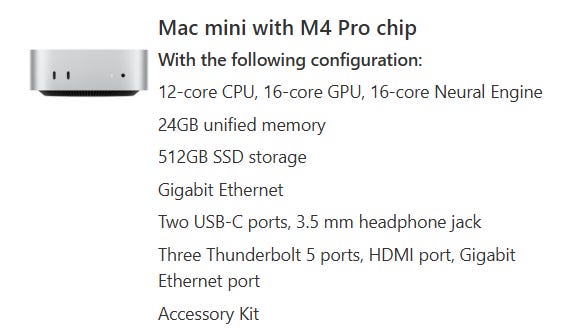
The future muscle: a Mac mini sitting at the office, which is where the sub-agents will live.
Setup was almost suspiciously easy
I’ll be honest: I expected this to eat a weekend. It didn’t.
Because Hermes ships the harness, I skipped the part that usually eats the weekend. I didn’t have to hand-craft memory files or wire up workflows from scratch. The real work was pointing Hermes at GPT-5.5 and connecting it to a fresh Telegram bot, and then Chief was responding in his own thread.
The genuinely hard part of any agent project was never the plumbing; it’s deciding what you actually want the thing to do. Once I’d answered that, the assembly was almost anticlimactic.
That’s worth saying out loud, because a lot of people assume building a personal agent requires some heroic technical lift. The pieces are all sitting right there now. The bottleneck is clarity, not capability.
Where this is going: orchestration
Here’s the part I’m most excited about, and the part that’s still ahead of me.
Right now Chief is the single agent I talk to. The plan is to turn him into a conductor. The Mac mini will host a set of sub-agents, specialized workers for specific kinds of tasks, and Chief’s job becomes orchestration: take my instruction, break it down, hand pieces to the right sub-agent, collect the results, and report back to me in Telegram like nothing complicated happened.
That’s the whole point of the architecture. I don’t want to manage a fleet of agents. I want to manage one agent who manages the fleet. I give Chief a goal; the Mac mini does the work; I get the answer. The complexity stays downstairs.
A Mac mini is a great little box for this. It’s quiet, low-power, always on, and happy to sit in a corner running jobs around the clock. It becomes the back office while Chief stays the front desk.
What I’ve learned so far
A few things stand out even this early:
The interface matters more than the model. GPT-5.5 is excellent, but the reason Chief feels useful is that he’s one Telegram message away. Reduce the friction to near zero and you actually use the thing.
Naming matters too, weirdly. Calling my instance Chief, and handing him a role, shaped how I set it up. I stopped thinking “what prompt do I write” and started thinking “what would I delegate to a competent person who never sleeps.”
And separation of concerns is everything. One agent to talk to, many agents to do the work. The moment I drew that line, the rest of the design fell into place.
Next steps
The orchestration layer on the Mac mini is the next build, and I’ll write that one up too, including what the sub-agents end up being and how Chief decides who gets what.
For now, I have a chief of staff who lives in my phone, runs on a $100 plan, and is about to get a team of his own.
Not a bad hire.
If you’re setting up something similar, the two decisions that mattered most for me were: pick a low-friction interface (Telegram, for me) and define the agent’s role before you write a single line of config. Everything else is just wiring, and with a harness like Hermes, a lot of that wiring is done for you.